I recently had the opportunity to talk to my eight-year old daughter and her third grade classmates for their school’s Career Day.
This was my first time talking about peds ICU (PICU) nursing with such a young crowd, and I was nervous. How do I hold their attention? How do I keep the descriptions of my job at their level, while not underselling the complexity of what I do? How do I talk with third graders about heavy topics, particularly if I’m telling them that my patients are just like them. Will it scare them too much to hear me talk about serious illness, injury and death in young children?
As someone working in the grief space, I knew it was important to be courageously honest, forthright and steady with them about these topics. Adults need better freedom and verbiage around the topics of illness, death and grief. And the reason they need this is because they haven’t had it modeled to them since their own childhood. As I’ve learned over the years from my seasoned colleagues, particularly our incredible Child Life Specialists who have guided our patients’ young siblings through the patients’ hospitalizations and deaths, I knew these third graders deserved clarity and openness from me in an age-appropriate way.
So I took a deep breath and dove in.
My slides covered the following topics:
- What does ‘pediatrics’ mean, and what is ‘intensive care’?
- What are some examples of a PICU patient?
- Kidney transplant (I was impressed one of the kids was able to tell me, ‘The kidney cleans the blood!’)
- Liver transplant
- Accidents (car accidents, falls)
- Ate the wrong things! (batteries, coins, Grandma’s medicine)
- Surgeries to straighten out your back
- Yucky infections in the brain, blood or lungs
- And lots more!
- What’s a normal day?
- Here, I outlined a straightforward day from 0700-1930 to demonstrate the depth of patient assessment, total patient care (diaper changes, bed baths), technology management, teamwork helping other nurses, and psych/social care with the parents/caregivers.
- What I love about PICU nursing
- Being part of an amazing team that helps our patients try and get better
- Meeting so many people from around the world
- Helping families through the hard times
- Therapy dogs and cool robots in the hospital!
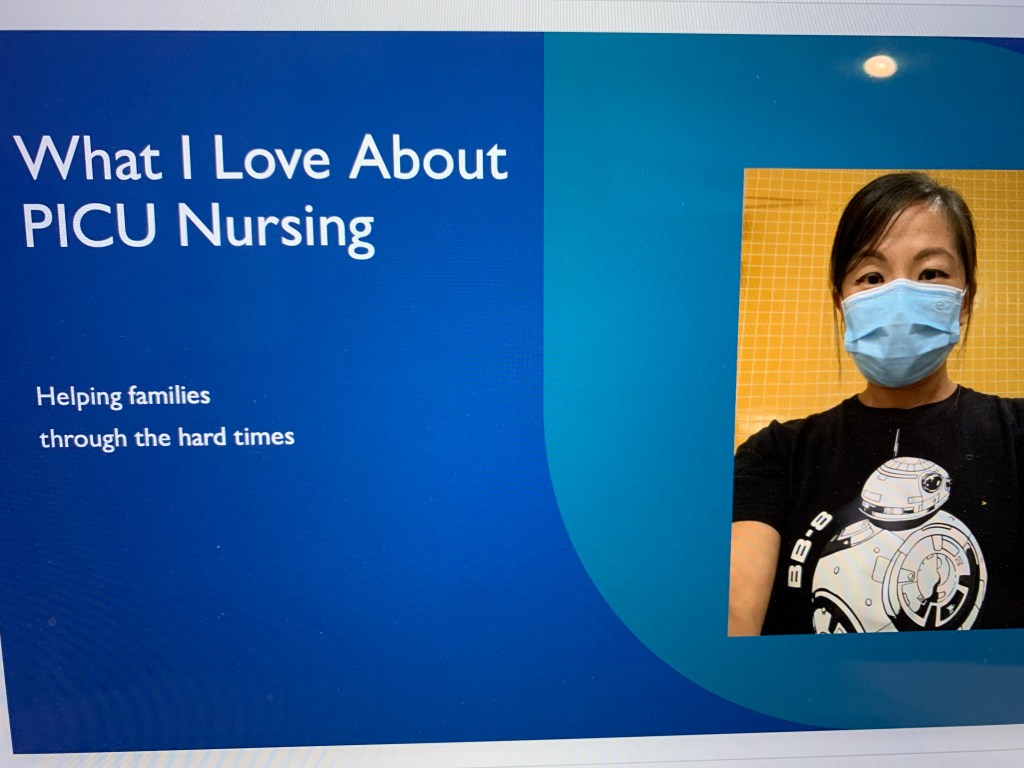
This is the slide where I took the opportunity to state, with the teacher’s permission, that some of my patients do die, and it’s an incredible privilege to take care of them and support their families through that process. I shared with them the story of a complex patient we had gotten to know over many years in our unit, and how we all wore Star Wars shirts to honor his love for the show when he died.
The kids in the classroom paid rapt attention and didn’t appear phased in the least. They were curious, attentive and enthusiastic, and not just about the ‘lighter’ aspects like the dog therapy and the cool robot our hospital is starting to use for medication delivery and other tasks.
I was impressed and touched by the questions the kids asked at the end. If you look at the questions carefully, you can see how much these kids actually understand about the realities of illness and death, and how thoughtful they are about it all.
Have you ever taken care of a two-day old baby?
Have any of your patients ever died?
Does anyone bring presents to the patients if they can’t be home for the holidays?
Are you ever like a therapist to the parents because they feel sad or worried about their child?
What was wrong with the patient who died [in the story you shared]? (I cited the need for privacy here, and just said the patient had a lot of complex medical problems over the years.)
If a child has cancer and is really sick, can they go outside of the hospital?
Why did you have so many slides with the same title, “Why I Love Being a PICU Nurse”?
Why aren’t you taking care of your patient right now?
Presenting to kids about PICU nursing may very well be my new favorite speaking opportunity! What a joy to be able to tell them about this very special profession.
 The Heart of Nursing